
Everyday Carry: What the Considered Life Fits in Your Pocket
8 MIN READ
A Practical Question That Became a Philosophy
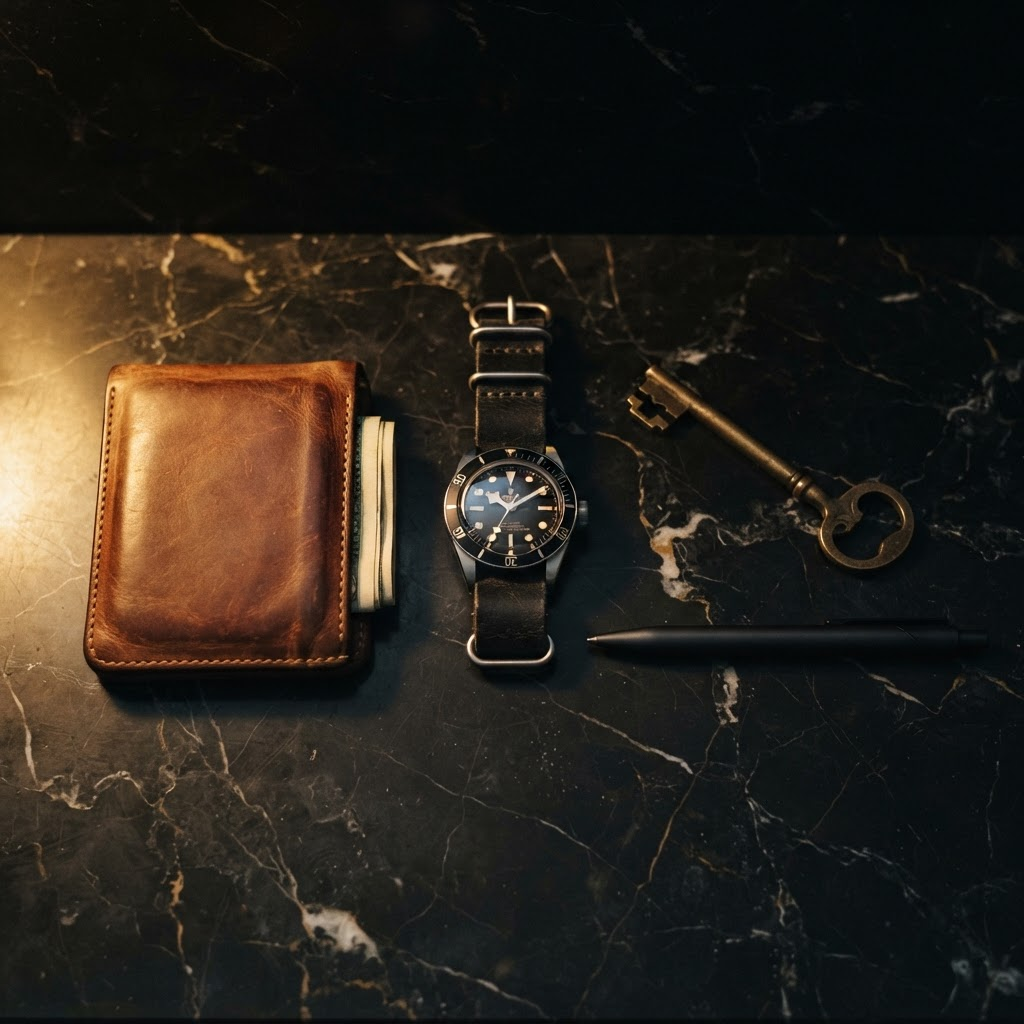
Everyday carry — EDC, if you've spent time in the corners of the internet where this is a genuine obsession — began as a practical question: what do you actually need on you, every day, no matter what? Over time it became something closer to a philosophy of restraint.
The appeal isn't the objects themselves, though a well-chosen watch or a hand-stitched wallet earns its place. It's the exercise of deciding, deliberately, what deserves a spot in your pocket and what doesn't. In a world of accumulation, that's a small act of editing — a daily vote for what actually matters.
The community around EDC has its own vocabulary and its own debates — titanium versus brass, mechanical versus quartz, minimal versus modular — but underneath the gear talk is a shared premise: constraints make decisions easier, and a pocket is one of the smallest, most honest constraints there is.
Materials That Age Instead of Wearing Out
The best EDC setups tend to favor materials that age rather than wear out — leather that develops a patina, brass that darkens, steel that keeps its edge. Objects built to be used, not replaced, mirror the same intentionality found in any considered ritual.
There's a practical reason for this beyond aesthetics. An object designed to improve with use rewards the habit of carrying it daily, rather than punishing it. A wallet that looks better after five years of use encourages the same five years of consistent behavior — carry, use, repeat — the way any good ritual does.
This is also where EDC culture quietly overlaps with a much older idea: that the objects you touch every day should be chosen with the same care as the habits you keep every day. A cheap pen that fails mid-signature and a habit that fails mid-week are, in a sense, the same kind of failure — a lack of intention at the point of friction.
Editing, Not Accumulating
The hardest part of building a considered everyday carry isn't finding good objects — it's removing the ones that don't earn their place. Most people's pockets, bags, and desks accumulate by default rather than by decision. EDC culture, at its best, is the discipline of reversing that default.
That same principle — fewer things, chosen with intention — is exactly the standard we hold VIP Rituals kratom gummies to. Ten count, one flavor profile, made to be a considered part of the day rather than one more thing cluttering it. A pouch that fits in the same pocket as everything else you decided was worth carrying.
The same restraint that defines great everyday carry shows up in how we make VIP Rituals kratom gummies.
Shop VIP Rituals kratom gummiesFrequently Asked Questions
- What are the core categories of everyday carry?
- Most EDC setups center on a wallet, a watch or timepiece, a pen or notebook, and a key or multi-tool — chosen for durability and daily use rather than novelty.
- Why do EDC enthusiasts prefer materials like brass and full-grain leather?
- These materials develop a patina and visible history with use, rather than degrading. That encourages daily carry instead of discouraging it, since the object improves the more it's actually used.
- Is everyday carry just about expensive gear?
- No — the underlying discipline is editing, not spending. The goal is deciding deliberately what deserves a spot in your pocket, which is as much about removing clutter as it is about choosing quality objects.
- How does EDC culture relate to daily rituals more broadly?
- Both are built on the same principle: fewer things, chosen with intention, repeated consistently. A considered pocket and a considered daily ritual are different expressions of the same discipline.